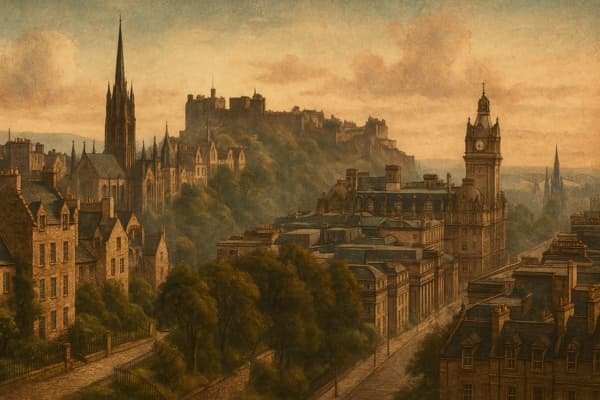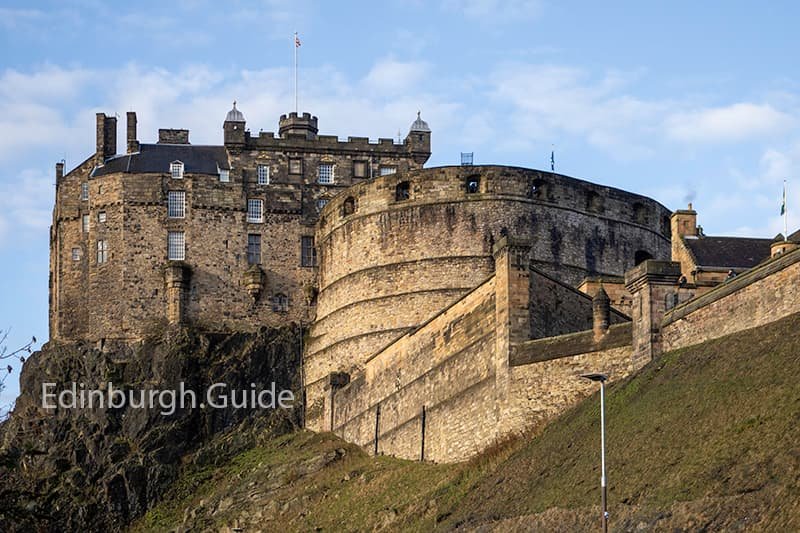
A visit to Edinburgh Castle is one of the most defining experiences in the city. Rising dramatically from Castle Rock, the fortress has shaped Edinburgh’s skyline and its history for centuries. From the Esplanade to the inner wards, the castle tells a story of power, defence, ceremony, and national identity, all within a relatively compact site that rewards unhurried exploration.
Bang on Time!
One of the castle’s best-known traditions is the One O’Clock Gun, fired daily at 1pm (except Sundays). Introduced in the mid-19th century as a time signal for ships in the Firth of Forth, the gun still serves as a living ritual rather than a historical re-enactment. Visitors often gather well in advance, drawn by the expectation as much as the sound itself. When the gun fires, the sudden bang echoes across the city, briefly uniting castle and streets below in a collective instant.
At the spiritual heart of the castle lies the Scottish National War Memorial, a place of solemn remembrance set apart from the busier visitor routes. Unlike outward-facing monuments, the memorial focuses on remembrance rather than spectacle. Inside, the names of those who died in service are preserved in handwritten rolls of honour, representing every part of Scotland. The memorial’s architecture, stained glass, and subdued light encourage guests to reflect, delivering a potent counterpoint to the castle’s more martial elements.
The castle’s military story is further examined through its museums and historic buildings, including the National War Museum and several regimental displays. These collections trace Scotland’s role in conflicts at home and abroad, using uniforms, weapons, medals, and personal effects to humanise centuries of service. Together with the surrounding barracks and parade spaces, they underline the castle’s long function as an active garrison rather than a purely symbolic stronghold.
Tucked quietly within the castle walls is St Margaret’s Chapel, the oldest surviving building in Edinburgh. Small, simple, and easily overlooked, the chapel dates from the early 12th century and stands in marked contrast to the fortress architecture around it. It was built in memory of Saint Margaret of Scotland, wife of King Malcolm III (Canmore), who was known for her deep piety, charity, and influence on religious reform in medieval Scotland. Canonised in 1250, Margaret was remembered as a figure of compassion and learning, and the chapel dedicated to her reflects those values in its modest scale and quiet atmosphere. Today, it remains a place of contemplation and, at times, small weddings, an intimate reminder that Edinburgh Castle is not only a site of war and power but also of faith and human devotion.
Beyond its museums and monuments, Edinburgh Castle also offers some of the finest views in the city. From its ramparts, visitors can look across Princes Street, the Old and New Towns, and out towards the Firth of Forth. These viewpoints reinforce why the site was so hotly disputed in earlier centuries—and why it remains such a powerful symbol today. A visit to Edinburgh Castle is more than merely observing landmarks; it is about grasping how geography, history, and national memory come together at the very heart of the capital.