
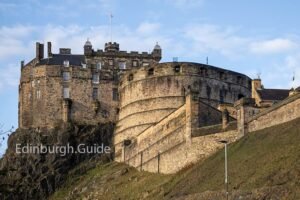
- Edinburgh Castle is a 0.4-mile walk from Waverley Station. It’s uphill all the way, so consider a Taxi (Taxi rank on Waverley Bridge) if mobility is an issue.
A visit to Edinburgh Castle is one of the defining experiences of the city. It dominates the skyline of Edinburgh from Castle Rock and has been a key feature of the city’s landscape and history for centuries. There’s a great deal of story to be had in the castle, covering all the bases of power, defence, ceremony and national identity, and it’s all crammed into a very small site which is very much worth taking the time to explore properly.
Bang on time
One of the castle’s better-known traditions is the One O’Clock Gun, which is fired every day at 1 pm (it’s not fired on Sundays). It was introduced in the mid-19th century as a time signal for ships in the Firth of Forth and is still a living tradition rather than a re-enactment. People often queue up well in advance just to be there when it goes off. The actual sound of the gun is a rather sudden bang which reverberates right across the city, and for a moment or two at least, the castle and the city below are in fact one.
Right at the heart of the castle is the Scottish National War Memorial, a place of remembrance in itself rather than one designed to be a showpiece. It’s a very different proposition to the more ‘out there’ of the castle’s attractions. The rolls of honour are all handwritten and contain the names of every Scot who died in service. It’s a very quiet, contemplative space with the architecture, the stained glass and the lighting all contributing to a very solemn atmosphere. It’s the very antithesis of the more martial aspects of the castle.
The castle’s military history is further explored through its museums and historic buildings, most notably the National War Museum and a number of regimental exhibits. These tell the story of Scotland’s military involvement both at home and abroad through the use of uniforms, weapons, medals and personal effects. In conjunction with the barracks and parade grounds, they serve to reinforce the castle’s long-standing role as an active garrison rather than simply a ceremonial fortress.
Hidden away in the castle walls is St Margaret’s Chapel, Edinburgh’s oldest building. It’s a very small, very simple chapel, quite unobtrusive in the midst of all the other architecture. It dates from the early 12th century and is a very different building to the fortress that surrounds it. It was built in honour of Saint Margaret of Scotland, wife of King Malcolm III. Margaret was a very pious woman, known for her charity and her influence in the realm of religious reform. She was canonised in 1250 and was remembered as a very charitable and learned woman. The chapel is a very modest building and reflects that in its simplicity. It’s still a place of quiet contemplation and at times is used for small weddings. It’s a very quiet reminder that Edinburgh Castle is not just a place of war and power but of faith and devotion as well.
Beyond the museums and monuments there are some of the very best views in the city to be had from Edinburgh Castle. You can look down over Princes Street, across the Old and New Towns and out over the Firth of Forth from the ramparts. That’s why it was such a contested site in earlier times and why it continues to be such a potent symbol. A visit to Edinburgh Castle is not simply about looking at the sights; it’s about understanding how the geography of the place, the history of the place and the national memory of the place all converge at the very centre of the capital.
Edinburgh Castle is part of Historic Environment Scotland.
If you’re going to be travelling around Scotland then you may want to consider getting an Explorer Pass. It could well save you money and make visiting the various attractions a lot easier.
