
George Street: The Grand Boulevard of the New Town
Running through the heart of Edinburgh’s elegant New Town, George Street is one of the capital’s finest thoroughfares. Today, it is known for stylish shops, restaurants, cafés, bars, and offices, but its story stretches back to the ambitious plans of the 18th century, when Edinburgh sought to reinvent itself.
Broad, symmetrical, and lined with impressive Georgian architecture, George Street remains one of the city’s great civic spaces, where history, commerce, and modern Edinburgh life meet.
Why is it called George Street?
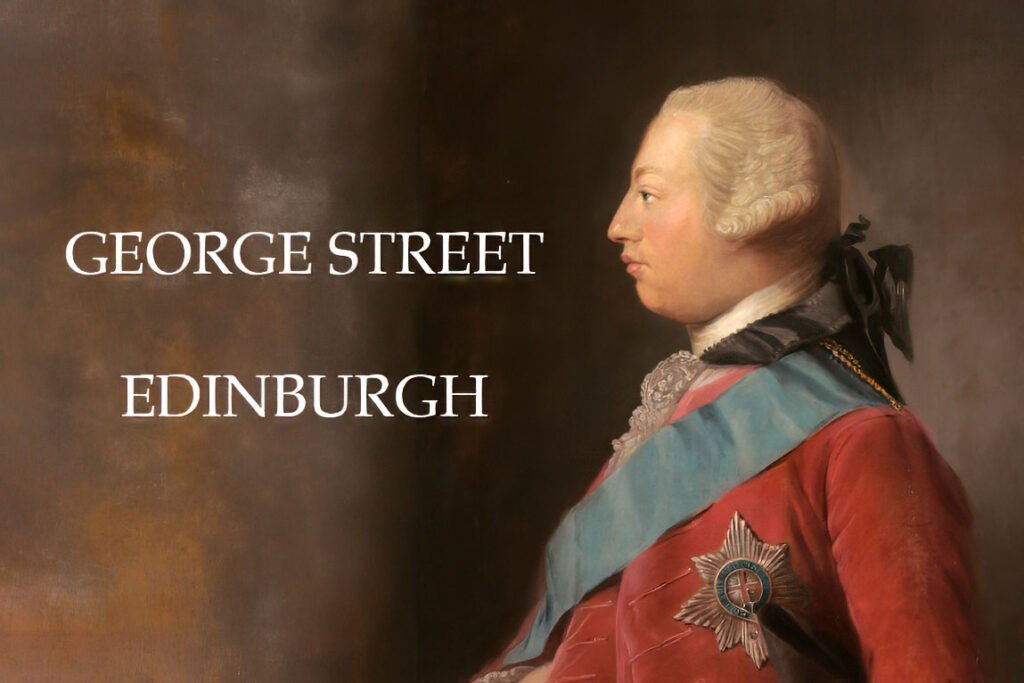
George Street was named in honour of King George III, who came to the throne in 1760 and reigned for almost sixty years. The naming formed part of a wider political gesture during the planning of Edinburgh’s New Town.
Many of the surrounding streets also reflected the union between Scotland and England. Queen Street commemorated Queen Charlotte, George III’s wife, while Princes Street honoured the king’s sons. Nearby Hanover Street recognised the royal House of Hanover.
Together, these names helped underline loyalty to the British monarchy and the Union at a time when Edinburgh was presenting itself as a confident, modern capital.
The birth of the New Town
By the mid-1700s, Edinburgh’s medieval Old Town had become desperately overcrowded. Thousands of people lived within towering tenements squeezed inside the city walls, and wealthier residents were beginning to move elsewhere.
In 1766, a competition was held to design an entirely new district to the north of the old city. The winner was a young architect called James Craig, whose bold grid pattern would become one of Europe’s greatest examples of Enlightenment urban planning.
George Street formed the centrepiece of his design.
Unlike the narrow closes and winding streets of the Old Town, George Street was designed as a broad east-west boulevard. Craig originally imagined it as an impressive avenue with gardens running along its centre, creating a grand processional route through the new district.
Although later developments altered the landscaping, the street still retains much of that original sense of space and dignity.
A fashionable address
As the New Town developed during the late 18th and early 19th centuries, George Street became one of Edinburgh’s most prestigious addresses.
Elegant Georgian townhouses lined both sides of the road, occupied by lawyers, merchants, bankers and wealthy professionals attracted by cleaner surroundings and modern conveniences.
Many of these buildings survive today, although their interiors have often been converted into shops, restaurants, hotels and offices. Their classical proportions and carefully planned facades continue to define the character of the street.
Walking along George Street today offers an excellent opportunity to appreciate the architectural vision that earned Edinburgh’s Old and New Towns UNESCO World Heritage status.
The Assembly Rooms
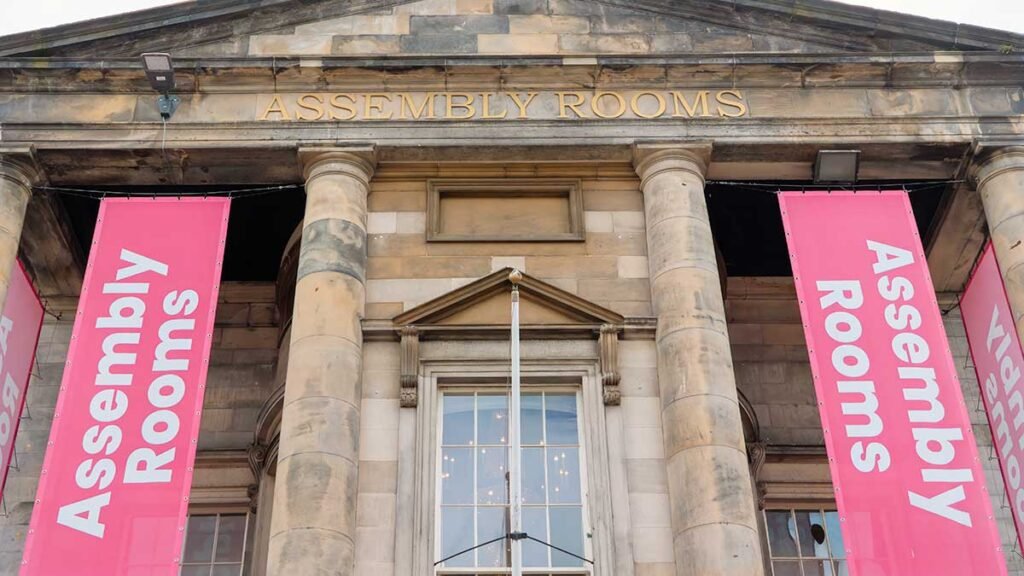
One of George Street’s finest landmarks is the Assembly Rooms, opened in 1787.
Designed by architect John Henderson, the building became the social heart of Georgian Edinburgh. It hosted grand balls, concerts, dances and civic gatherings where society’s elite came to see and be seen.
The magnificent ballroom, chandeliers and classical interiors remain among the most impressive public rooms in Scotland.
Today, the Assembly Rooms continue to host concerts, festivals, exhibitions, weddings and events, playing an important role during the Edinburgh Festival season.
St Andrew Square and Charlotte Square
George Street stretches between two of Edinburgh’s most important public squares.
To the east lies St Andrew Square, once surrounded by elegant residences and now a busy commercial centre with gardens and restaurants.
At the western end stands Charlotte Square, regarded by many historians as the masterpiece of the New Town. Designed by Robert Adam, its harmonious terraces represent some of the finest Georgian architecture anywhere in Britain.
Together, the two squares frame George Street and reinforce the carefully balanced planning of James Craig’s original vision.
Shopping and business
During the 20th century, George Street evolved into one of Edinburgh’s premier shopping destinations.
Banks established impressive headquarters along the street, reflecting Edinburgh’s reputation as a major financial centre. Luxury retailers, jewellers and fashion boutiques also moved in, giving George Street an upmarket reputation that continues today.
Visitors will find a mix of national brands, independent businesses and flagship stores, while many historic buildings have been adapted for modern commercial use without losing their Georgian appearance.
Dining and nightlife
As offices close for the day, George Street takes on a different atmosphere.
The street has become one of Edinburgh’s most popular destinations for outdoor dining, cocktails and evening entertainment. Pavement cafés and restaurants spill onto widened terraces during the warmer months, creating a lively continental feel in the city centre.
Whether stopping for coffee, enjoying lunch or spending an evening with friends, George Street offers something for almost every taste.
Festivals and events
George Street frequently hosts seasonal events and celebrations.
During the festive period, it has often featured attractions as part of Edinburgh’s Christmas programme, while summer sees visitors from around the world passing through during the Edinburgh festivals.
Its wide layout makes it well-suited for temporary installations, markets and public gatherings, reinforcing its role as one of the capital’s principal civic spaces.
George Street today
More than 250 years after James Craig drew his remarkable plan, George Street remains at the heart of modern Edinburgh.
The street is a shopping district, business hub, social destination and architectural showpiece. Few streets illustrate the contrast between Edinburgh’s medieval origins and its Enlightenment ambitions so clearly.
Buidings of interest in George Street
- Royal Society of Edinburgh – Nos 22-24 – Scotland’s National Academy brings together the expertise of its 1,800 Fellows to offer independent advice to policymakers and encourage the next generation of innovative thinkers.
- The New Town Church of Scotland – No 13 – completed in 1784.
- The Dome – No 14 – This is perhaps the most famous building on the street. Built in 1775 as the Physicians’ Hall, it became the headquarters of the Commercial Bank of Scotland in the 1840s. Today, its neoclassical facade and iconic glass cupola house a popular bar and restaurant, renowned for lavish Christmas decorations.
- Assembly Rooms – No 54 – An elegant, versatile multi-purpose venue.
- Northern Lighthouse Board – No 84 – This well-preserved 19th-century townhouse serves as the official headquarters responsible for overseeing and monitoring all lighthouses in Scotland – Look out for the flashing Lighthouse above the door – not open to the public.
- Hamilton & Inches – No 87 – This impressive building, distinguished by the Royal Crest above the shop, serves as the showroom for Edinburgh’s leading silversmiths and clockmakers and holds a Royal Warrant.
Stay on George Street
You’ll find George Street one of the most convenient places to stay in Edinburgh, especially if you want to be in the heart of the New Town. Enjoy elegant Georgian architecture, excellent restaurants, stylish bars, and high-end shopping right on your doorstep, so you spend less time travelling and more time enjoying the city.
You can easily walk to many of Edinburgh’s best-known attractions. Stroll to Princes Street, St Andrew Square, the Scott Monument, and Edinburgh Waverley station in just a few minutes. Reach the Royal Mile, Edinburgh Castle, and the Old Town on foot in about 10 to 15 minutes. Edinburgh Trams also stop nearby, so you can travel to and from Edinburgh Airport without needing a taxi.
Whether you visit for a weekend break, the Edinburgh Festivals, Christmas markets, or a business trip, staying on or around George Street puts you close to the action and gives you an excellent base for exploring the rest of the city.
- Le Monde Hotel
- InterContinental Edinburgh The George by IHG
- Luxury/Flat Apartment – 36 George Street
- Modern George Street Studio sleeping 2
- JOIVY Modern Studio
- RÌGH Residences – George Street
- Tigerlily
- Eden Locke
- Kimpton Charlotte Square by IHG
Affiliate link
Food & Drink in George Street





Edinburgh Quick Links
- Edinburgh Attractions
- Royal Mile – Places to visit
- What’s On
Share this page.